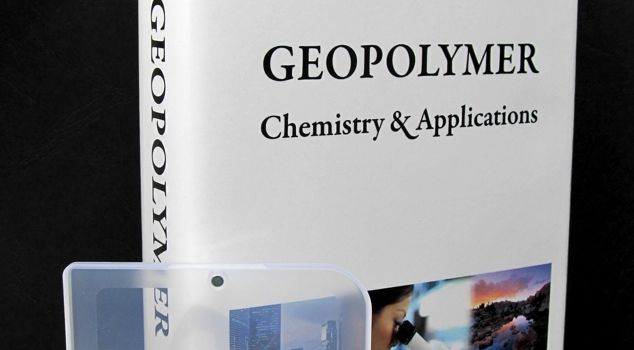
Professeur Joseph DAVIDOVITS présente son premier cours pour débutant en chimie des géopolymères et ses applications.
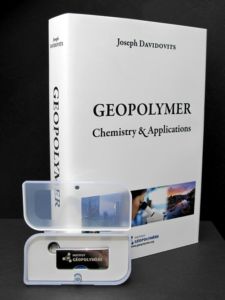
ISBN: 9782951482036
Achetez votre exemplaire du livre à La Boutique Géopolymère
Avec votre commande, vous recevrez deux objets: la nouvelle édition du livre Geopolymer Chemistry and Applications et une clé mémoire USB avec 5,5 heures de didacticiels en vidéo (la série Geopolymer for Newcomers) et jusqu’à 10 heures de vidéos en bonus pour un total de 15 heures de vidéos.
ATTENTION: le livre et le cours sont intégralement en anglais.
Regardez cette petite présentation en anglais, elle inclut de petits extraits et une vue du laboratoire de l’Institut Géopolymère.
Quel est le contenu de ce cours en vidéo ?
Tout d’abord, ce cours est intégralement en langue anglaise. Ce cours en vidéo est divisé en 9 chapitres. Son objectif est de vous donner une introduction, une vue générale de la science des géopolymères. Il concerne les professeurs d’universités, doctorants, étudiants en maitrise, les chercheurs de l’industrie en auto-formation. Bien que chaque concept soit bien développé dans le livre Geopolymer Chemistry and Applications, vous pouvez avoir besoin de rechercher une connaissance scientifique complémentaire dans les livres de référence et les manuels en science des matériaux, chimie et physique. Cette formation est, par conséquent, un bon complément pour votre compréhension de tous ces concepts, et pour l’enseignant, c’est une aide utile à l’apprentissage de la chimie des géopolymères.
En bonus, vous trouverez « Building the pyramids of Egypt », la conférence de 1h30 de Joseph DAVIDOVITS sur sa célèbre théorie sur la méthode construction des pyramides d’Égypte en calcaire réaggloméré.
Que sont ces fichiers ?
Vous avez besoin d’un ordinateur capable de lire les vidéos au MPEG4 H.264 AVC. Ces vidéos sont lisibles sur tout ordinateur récent, tablette, téléphone mobile, ou certaines télévisions capables de lire ces fichiers sans difficulté. Vous pouvez par exemple utiliser des lecteurs gratuits comme Apple QuickTime, VLC ou MPlayer ou d’autres lecteurs vidéo. Ce sont des vidéos de haute définition, donc votre ordinateur doit être suffisamment puissant pour les ouvrir. Téléchargez ce petit extrait pour vérifier la compatibilité de votre ordinateur; il est à la taille et au format exact de ce que vous recevrez. Merci de faire ce test avant de commander.
sample-geopolymer-video-tutorial.mp4 – 7.95 Mo – 47s – 1024x640p – MPEG4 H.264 AVC
Contenu de ces formations
Topic #1: from invention to industrialization; 1972-2008: 36 years of research, development and applications
The course shows how the development of the geopolymer science concept was governed by the need to solve global technological problems in the industrial fields of extractive minerals, ceramics, cements, building materials, decorative stones and restoration works, fire and heat resistant composites, high-tech composites for aerospace, aircraft, naval and automobile, radioactive and toxic waste containment, thermal insulation.
It further provides a clear distinction between geopolymer and alkali-activated materials and highlights some historical milestones.
Upon completion of this course, you will be able to make a clear cut between geopolymer technologies and low-tech/alkali-activated systems.
Topic #2: The mineral geopolymer concept
The course discusses the differences between the ionic and covalent bonding concepts. It introduces the molecular representation for geopolymeric structures based on the most recent results of physicochemical science.
Upon completion of this course, you will be able to describe the fundamental principles and concepts of geopolymer science and technology.
Topic #3: Macromolecular structure of natural silicates and aluminosilicates
This course describes the numerous natural minerals and pinpoints their similarities to geopolymeric molecules (monomers, dimers, trimers, etc..) and macromolecules (polymers). It involves:
– Ortho-silicates, ring silicates,
– Linear poly-silicates: pyroxene, amphibole
– Sheet poly-silicates: kaolinite, pyrophillite, muscovite
– Framework poly-silicates: quartz, feldspars, feldspathoids, zeolites
Upon completion of this course, you will be able to explain the properties of the minerals used as raw-materials in geopolymer manufacturing.
Topic #4: Scientific tools, X-rays, FTIR, NMR
This course selects which analytical method is the most appropriate for the study of geopolymers, namely Nuclear Magnetic Resonance Spectroscopy.
Topic #5: Macromolecular structure of Soluble Silicate, Poly(siloxonate) with Si:Al=1:0
This course revisits an old industry namely that of waterglass, a basic geopolymeric chemical ingredient. It involves:
– History of soluble silicates (waterglass), manufacture,
– Macromolecular structure of (Na,K)–silicate glasses,
– Hydrolysis, depolymerization of solid silicates
– Structure of poly(siloxonate) solutions (waterglass)
– NMR spectroscopy, macromolecular structure, identification of soluble species
– Density, Viscosity, pH, alkali silicate powders
Upon completion of this course, you will be able to understand the differences between Na-silicates and K-silicates and how to apply this new knowledge in the design of high-quality geopolymeric products.
Topic #6: Macromolecular chemistry of Metakaolin MK-750 and related geopolymers with Si:Al=1-3
This course follows the various structural changes of the mineral kaolinite into metakaolin and their implications in the geopolymerization mechanisms. It describes:
– Dehydroxylation mechanism of kaolinite
– Chemical mechanism, ortho-sialate molecules
– Kinetic, Chemical attack, Exothermic reaction
– Formation of Na-based geopolymeric frameworks: nepheline, albite, phillipsite
– Formation of K-based geopolymeric frameworks: kalsilite, leucite
Upon completion of this course you will be able to :
– Outline the identification and the study of metakaolin raw materials for geopolymeric precursors with selected instrumental methods.
– Identify the reaction mechanism from monomers, oligomers to polymers, kinetics and geopolymerization parameters.
Topic #7: Low-energy, Low-CO2 geopolymer cements
This course provides a thorough presentation and discussion on the basic knowledge about geopolymer cements and related building products based on the by-products of industrial and mining activities or Coal-Power-Plants: fly ashes. It comprises:
– MK-750 / slag-based geopolymer cement
– Rock-based geopolymer cement
– Fly ash-based geopolymer cement
– Greenhouse CO2 mitigation with geopolymer cement: Examples of low CO2 mitigation with geopolymer cements
Upon completion of this course, you will be able to describe the fundamental principles and concepts allowing the use of geological outcrops as well as mineral by-products and tailings, fly ashes, in low-energy and low-CO2 geopolymer cements manufacture.
Topic #8: Low-energy, Low-CO2 geopolymer ceramics
This course offers a comprehensive review of the impact of Geopolymer technology on the manufacture of Low-energy ceramics and bricks. It involves:
– Geopolymerization mechanism of kaolinite under co-valent bonding concept
– Geopolymeric setting at temperature below 65°C, 80°C and 450°C
– Resistance to water; physical properties
– Application to archaeological ceramics: 25.000 year-old geopolymer ceramic: Venus of Dolni Vestonice
Upon completion of the course, you will be able to apply the geopolymeric ceramic concept to implement modern Low-energy ceramic processing for the production of regular ceramic tiles (glazed) or fired bricks.
Topic #9: User-Friendly Systems
Although geopolymerization does not rely on toxic organic solvents but only on water, it needs chemical ingredients that may be dangerous. Some of them may be classified as user-hostile systems and therefore require some safety procedures.
Upon completion of the course, you will be able to understand the absolute necessity of implementing user-friendly geopolymeric systems.
Bonus
Geopolymer Webinar
Un enregistrement de 5 heures de presentation de Joseph Davidovits en Octobre 2013 sur les géopolymères en général, se concentrant sur les applications industrielles et la science. C’est une bonne introduction à la manière d’aborder ce sujet de la bonne façon.
GeopolymerCamp Keynotes
Joseph Davidovits présente chaque année durant cette conférence un état de la R&D et de l’industrialisation des géopolymères en général.
Building the pyramids of Egypt
Joseph DAVIDOVITS présente sa célèbre théorie sur la manières dont les Égyptiens ont construit les pyramides avec un calcaire ré-aggloméré.
LTGS brick conference
Joseph DAVIDOVITS présente la fabrication de briques avec peu d’énergie au Ceramics and Brotherhood Symposium, Verona, Italie, en Juillet 2008.
Davya 60 cement tutorial and Datobe ceramic tutorial
Deux petits didacticiels sur la manière de manipuler un ciment et une céramique géopolymère, avec les trucs et astuces comme un technicien du laboratoire de l’Institut Géopolymère sait le faire.
Achetez votre exemplaire du livre à La Boutique Géopolymère
INCLUS AVEC VOTRE COMMANDE: Rapport du Congrès Mondial Géopolymère 2005
(Geopolymer, green chemistry and sustainable development solutions)
La clé mémoire USB contient les actes du Congrès Mondial Géopolymère 2005 qui s’est tenu en France et en Australie sur la science des géopolymères, sa technologie et ses applications. Plus de 180 participants du monde entier ont assisté au congrès, 85 institutions de recherches et sociétés internationales ont présenté 75 conférences. Elles couvrent une large gamme de sujets de la chimie des géopolymères, matière première et déchet industriel, ciment géopolymère, béton géopolymère (incluant les géopolymères à cendres volantes), applications dans les matériaux de construction, applications dans les matériaux high-tech, matrice pour composites resistants au feu et à la chaleur, et applications en archéologie.
Ce livre des proceedings est épuisé. La clé mémoire USB contient toutes les contributions reçues (résumés étendus inclus, et quelques photos de l’événement). Tous les articles de la clé mémoire USB sont les exactes copies de leurs versions imprimées, ainsi vous pouvez les utiliser comme référence. Il est aussi compatible avec les systèmes PC, Mac et Unix, tous les fichiers sont au format standard PDF. Vous pouvez imprimer, copier ces articles, et utiliser le moteur de recherche pour trouver un mot particulier.
POSSÉDEZ 3 RAPPORTS EN UNE SEULE COMMANDE
Une collection unique d’articles scientifiques
133 articles – 1190 pages
ISBN: 9782951482005
Comme BONUS GRATUIT, la clé mémoire USB inclut les actes des congrès Geopolymer ’88 et Geopolymer ’99. Nous avons fait cela, car ces rapports sont en rupture de stock. Ils sont les exactes copies de leurs versions imprimées, ainsi vous pouvez les utiliser comme une référence et rechercher le bon article à la bonne page.
Pour en savoir plus sur le contenu, lisez la Table des Matières.
