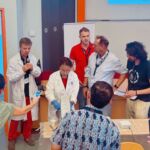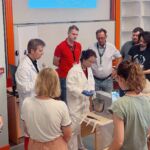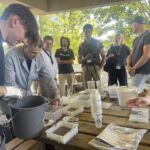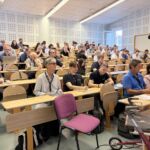
The Geopolymer Camp 2026, was held on July 8th to July 10th at the Campus of the University of Picardie, in Saint-Quentin, France. You will find below the Keynote conferences and the list of short communications.
Special Thanks to our Sponsors:

Xatico: Performance Minerals for Geopolymer Solutions
XATICO sells, distributes and advises on mineral materials, offering a wide range of carefully selected products from the world’s best production sites. Its large customer base in Europe covers many industries, including geopolymers. XATICO’s team of experts provides technical and formulation support, customised distribution, consignment stock and delivery services throughout Europe.

Geosil®: Silicate binders and hardeners for geopolymeric systems
The Geosil® product line are the first aqueous silicate solutions specifically designed for geopolymerization. In addition, Woellner supplies a wide range of additives to help you achieve your desired properties.

temcon: Advance raw materials to formulate geopolymers
temcon supplies cutting-edge raw materials to formulate geopolymers with superior performance. Our advanced solutions are specifically tailored for creating technical ceramics, cement and innovative binders. Optimize the thermomechanical strength of your geopolymer matrices using our premium metakaolins, selected fly-ashes, slags, microsilica and specialized additives to push the boundaries of your high-tech industrial applications.
Keynote Conference in video
Development of MALLET(™) for Radioactive Waste Encapsulation
Keynote by Stuart MacLachlan, Marta Fedorciuc-Onisa, Lucideon, UK
32 min, 133 MB. Click on the CC icon to ACTIVATE SUBTITLES. Watch it fullscreen.
Summary: This presentation, delivered by Stuart MacLachlan (Director of R&D at Lucideon Limited), explores the application of geopolymer binders for the long-term encapsulation and disposal of problematic intermediate-level nuclear waste. Developed in collaboration with Nuvia through the Innovate UK-funded MALLET project, Lucideon’s proprietary MIDAR® geopolymer technology offers a low-carbon, highly stable alternative to traditional Ordinary Portland Cement (OPC) and vitrification methods.
Nuclear decommissioning faces significant challenges with “orphan wastes”, legacy materials like Magnox sludges, machine oils, zeolites, and graphite blocks that lack clear disposal routes and choke current infrastructure. Standard cementation exhibits high porosity, low waste-loading capacity, and difficulty handling high-viscosity matrices, driving up containment volumes and overall costs.
Using non-radioactive simulants, Lucideon demonstrated that geopolymer systems significantly outperform traditional binders across key metrics:
- Magnox Sludge: Achieved a 40% increase in sludge volume capacity over OPC, reducing projected disposal costs by nearly €100 000 per cubic meter.
- Machine Oils: Successfully encapsulated up to 60 vol% oil, far surpassing the standard 9 vol% limit for OPC, with zero oil separation or surface pooling.
- Zeolites & Graphite: Provided robust chemical immobilization, matrix percolation, and minimal contaminant leaching during 90-day water immersion tests.
Scale-up testing, ranging from lab-scale acoustic mixing to 100-liter in-drum batches, confirmed low viscosity, excellent pumpability, and a negligible exotherm (a 2°C rise). Additionally, samples exposed to gamma radiation at the Dalton Cumbrian Facility displayed no dimensional changes or physical degradation. Overall, geopolymer binders present a scalable, cost-effective, and durable solution for long-term nuclear waste containment.
Chapters
00:00 – Introduction and Overview of Lucideon
02:26 – Geopolymer Capabilities and Key Industry Drivers
05:16 – Geopolymer Applications and Commercial Barriers
06:47 – Waste Hierarchies and Encapsulation Challenges
08:52 – The “Orphan Waste” Problem in the Nuclear Industry
10:33 – Comparing OPC, Vitrification, and Geopolymer Binders
13:48 – The MALLET Project: Encapsulation Testing Framework
17:15 – Case Study 1: Encapsulating Magnox Sludge (Volume and Cost Savings)
22:20 – Scaling Up: 12-Kilo to 100-Liter In-Drum Mixing Tests
24:27 – Case Study 2: Encapsulating Problematic Oils (Up to 60% Loading)
27:16 – Case Study 3: Ion-Exchange Zeolites and Leaching Resistance
28:14 – Case Study 4: Graphite Powder and Block Encapsulation
29:10 – Radiolysis and Gamma Radiation Exposure Results
30:38 – Summary and Moving from TRL 4/5 to Industrial Adoption
ACCESS TO THE PRESENTATIONS
Download and read the presentations given in front of the Geopolymer Camp attendance. Click here to access to the files.
PROGRAMME
The GeopolymerCamp 2026 spanned 3 days:
SPECIAL TOPICS OF INTEREST:
– Tutorial Workshop (short courses) for Newcomers, on wednesday;
– Focused Sessions:
1- Management of Radioactive wastes and Chemical wastes
2- Nano-molecular geopolymer chemistry
3- Geopolymer and Archaeology
Thursday, July 9, 2026
GEOPOLYMER CAMP
08:30 – 09:00: Registration
09:00 – 09:15: Welcome and messages
09:15 – 12:05: First session: Geopolymer Molecular Chemistry; Raw Materials, Scientific Investigations.
— Joseph Davidovits: introduction to the First session with reference to the book Geopolymer Chemistry and Applications 5th edition
— Jörg Lind, Wöllner GmbH, Germany: Geosil – Ready to use alkali silicates for Geopolymers.
— Carine Lefèvre, Xatico, Luxembourg: Metakaolins and mineral fillers in geopolymers
— Ralf Gordon-Tönnies, Temcon Solutions GmbH, Germany: Tempozz metakaolins, slags and fly ash
— Richard Wyn Huws, Geoslate Ltd, UK: Slate-based geopolymer material for the protection and thermal management of underground high voltage cable infrastructure as an alternative to concrete and thermal sand
— Dustin Lobner, Kohler Co, USA: Machine Learning for Geopolymer Formulation
— Yanjuan Chen, Auderghem, Belgium: 3D Printing of Cement-Free Slag-Based Binders
— Edoardo Verza, University of Parma, Italy: Monitoring of the Geopolymerization Process Using the One-Part Method
11:00 – 11:30: Coffee break
12:05 – 13:00: Second Session: Advanced geopolymer concrete formulation, the Einstein Telescope project
— Joseph Davidovits: introduction to the Second session, cf. GP-Book Chapter
— Niels Hulsbosch, Gerjan van de Walle, ET-Flanders, Belgium: The Einstein Telescope, 3rd generation gravitational wave detector pushing the boundaries of science and technology.
— Niels Hulsbosch, Buildwise, Belgium: The Einstein Telescope, From Excavated Rock to Low-Carbon Structural Applications: Geopolymer Innovations for the Einstein Telescope.
13:00 – 14:15: Free Sandwich Lunch
14:15 – 15:10: Third Session: management of radioactive waste (focused session)
— Joseph Davidovits: introduction to the Third session, cf. GP-Book Chapter
— Keynote : Stuart MacLachlan, Marta Fedorciuc-Onisa, Lucideon, UK: Development of MALLET(™) for Radioactive Waste Encapsulation
— Matthias Weiß, Framatome/Wöllner: Nuclear Waste Management: Solidification of Liquefied Ion Exchange Resin
15:10 – 17:00: Fourth Session: Geopolymer concretes Part (1)
— Joseph Davidovits: introduction to the Fourth session, cf. GP-Book Chapter
— Alex Reggiani, GeoMITS, Prignano Sulla Secchia, Italy: Self Compacting & Self leveling GP products for Concrete flooring or Road repairing
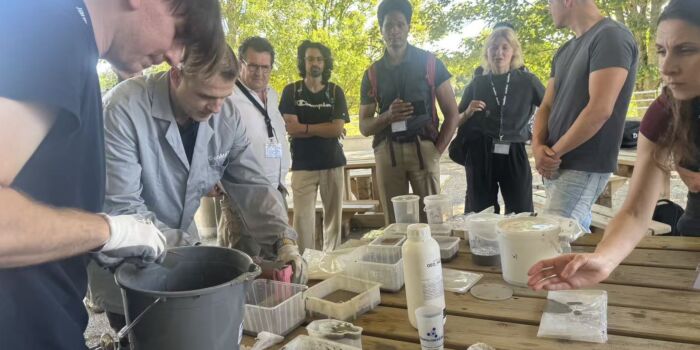
— On site live geopolymer mixing demonstration.
— William Hof, Geopolymer International, Las Vegas, USA: Automatic Mixing Machine for Geopolymer Cement.
16:10 – 16:40: Coffee break
Friday, July 10, 2026
09:10 – 10:15: Focused Session : Geopolymer and Archaeology
— Joseph Davidovits: Introduction to the focused session, cf. GP-Book Chapter
— Marco Scalet, CALCHÈRA San Giorgio, Grigno, Italy: Geopolymers for the Retrofit of Historic Buildings: A Sustainable Technological Solution
— Frédéric Davidovits: Roman concrete and geopolymer chemistry
10:15 – 10:45: Coffee break
10:45 – 13:00: Fourth Session: Geopolymer concretes Part (2)
— Marcos Fernandez, Lorena Freire, AIMEN Technology Centre, O Porriño (Spain): Assessment and Optimization of European CDW Streams for Geopolymer Mortars
— Jasper Vitse, Leuven University, Belgium: Use of pozzolans and CDW-fines in temPozz M92-based geopolymers
— Mouhamadou Amar, CERI Matériaux et Procédés, IMT Nord Europe, Douai, France and Geoffroy Bister, Belgium, Ceramic Research Centre, Mons, Belgium: Al2SiBuild: Validating Geopolymer Concretes from Local Resources to Industrial scale — An Interreg Cross-Border Approach
— Geoffroy Bister, Belgium, Ceramic Research Centre, Mons, Belgium: Study of the Printability of Geopolymer-Based Compounds Using Robocasting
— Robert Masse: Dioxink: Project to store CO2 in the ocean using geopolymer concrete tanks
13:00 – 15:30: Free Sandwich Lunch – Networking – Open discussions
Materials Sciences + Products ;
– Materials Technology & Engineering (+ civil engineering) – Cements – Concretes (+ raw materials, admixtures); – Sustainable / Eco Construction
– Groups – Discussions
– Materials Sciences + Products ; – Materials Technology & Engineering (+ civil engineering)
– Cements – Concretes (+ raw materials, adjuvants); – Sustainable / Eco Construction.
Photo Gallery