
Materials for the Third Millennium
Think Geopolymer and Geosynthesis!
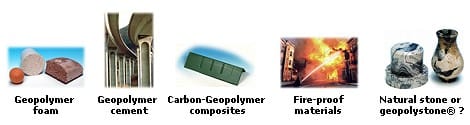
The last few years have seen spectacular technological progress in the development of geosynthesis and geopolymeric applications.
New state-of-the-art materials designed with the help of geopolymerisation reactions are opening up new applications and procedures, and transforming ideas that have been taken for granted in inorganic and mineral chemistry.
Since the discovery of the geopolymer chemistry by Prof. Joseph Davidovits (see also in the Library the scientific paper IUPAC 1976) this new generation of materials, whether used pure, with fillers or reinforced, is already finding applications in all fields of industry. These applications are to be found in the automotive and aerospace industries, non-ferrous foundries and metallurgy, civil engineering, cements and concretes, ceramics and plastics industries, waste management, art and decoration, retrofit of buildings, etc. One third of the recently updated book Geopolymer Chemistry & Applications is dedicated to geopolymeric applications. You may also go to the Geopolymer Library and download several papers, for example #21 Geopolymer cement review 2013.
Some of the geopolymer applications are still in development whereas others are already industrialized and commercialized. They will be listed in six (6) categories, namely:
Geopolymer Precursor
Geopolymer Resin, paint, binder, grout
Geopolymer cement, concrete, waste management, global warming
Applications with geopolymer cements and concretes are described in the section Geopolymer Cement with special emphasis on the introduction of user-friendly systems. It is striking to notice that Geopolymer cements manufacture emits 80 to 90% less CO2 (greenhouse effect gas) than Portland Cement. See in GLOBAL WARMING. They are perfect examples of Green Chemistry and Sustainable Development.
For information on Fly Ash-based geopolymer cements go to European Research Project GEOASH. For updated very recent detailed information, read Chapters 12, 24, 25 in Geopolymer Chemistry & Applications; you may also download previous papers in the Library .
Rock-based geopolymer cements are ideal for environmental applications, such as the permanent encapsulation of radioactive and other hazardous wastes, toxic metals, as well as sealants, capping, barriers, and other structures necessary for remedying toxic waste containment sites (see our European Research Project GEOCISTEM and the GEOPOLYTECH process). See also in the Library .
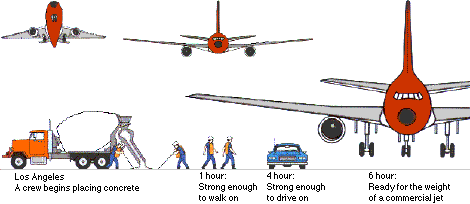
Rock-based geopolymer cements and concretes for building and repairing infrastructure have very high early strength, their setting times can be entirely controlled, and they remain intact for a very long time without the need for repair. See in Davidovits’ book, Geopolymer Chemistry & Applications, the Chapters 9, 10, 24 and 25. The strength of geopolymeric rock-based geopolymer concrete is such that a heavy Boeing or Airbus can land on a runway freshly patched with geopolymeric rock-based geopolymer concrete only four hours after patching has been completed. The discovery of this new cement was awarded with a Gold Ribbon by the American National Association for Science, Technology and Society (NASTS) in 1994 (Library paper #3 NASTS award ).
Geopolymer specialty
Geopolymer ceramic
Several decades ago, ceramicists tried to manufacture ceramic tiles at temperatures lower than 450°C, without firing. Geopolymer science masters the transformation of kaolinite, the major component of ceramic clays, into geopolymers of the poly(sialate) and poly(sialate-siloxo) types. Application of this chemistry yielded several technological breakthroughs pertaining to LTGS, Low-Temperature-Geopolymeric-Setting and geopolymerized modern ceramic processing. See in Chapter 23 of Davidovits’ book Geopolymer Chemistry & Applications .
Geopolymer high-tech/ fiber reinforced composite
Geopolymer composites have three main properties that make them superior to ceramic-matrix composites, plastics, and organic composite materials.
First:
Geopolymers are very easy to make, as they handle easily and do not require high heat.
Second:
Geopolymeric composites have a higher heat tolerance than organic composites. Tests conducted on Geopolymer carbon-composites showed that they will not burn at all, no matter how many times ignition might be attempted.
Third:
The mechanical properties of Geopolymer composites are as good as those of organic composites. In addition, Geopolymers resist all organic solvents (and are only affected by strong hydrochloric acid).
Before the discovery of geopolymerization, these three critical properties had not been incorporated into any one material. More information are available in applications called GEO-COMPOSITE and GEO-STRUCTURE and in Davidovits’ book Geopolymer Chemistry & Applications , Chapter 21.
An Example of the Development of Geopolymeric Composites and Cements That Improves Air Travel Safety and Airport Efficiency*
The Chapters of the book GEOPOLYMER Chemistry & Applications dedicated to these applications are referred to in italic.
A jet is preparing for takeoff from a runway in New York as a crew begins placing a section of geopolymer concrete (Chapters 24, 25) on a Los Angeles runway. The plane is equipped with a fire-resistant geopolymer-encased electronic flight recorder. The jet’s cabin has also been rendered fireproof with sandwich panels of carbon/Geopolymite® composites (Chapter 21) and geopolymer foam insulating boards (Chapter 22). The jet is also equipped with a highly advanced fireproof air filter. Several structural components of the jet, made with an advanced SPF Al superplastic aluminum alloy, have been manufactured at 550°C using compression ceramic tools made of geopolymer materials (Chapter 20).
When the plane is ready to land in Los Angeles, the runway repaired with Pyrament® concrete will be ready for it.
*This fictitious example illustrates possible applications that are or have been manufactured and/or patented by several companies
