
Long-Term Stability of Geopolymeric Materials
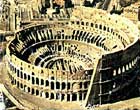
The task LONGTERM in the GEOCISTEM project dealt with the better understanding of long-term durability. It is difficult to predict extended durability on the basis of operating experience, laboratory experimentation and prototype testing. Two thousand years are generally accepted as a sufficient amount of time to permit decay of fission products that represent the most hazardous fraction in low-level rad-waste material. The present ongoing research involves geological, chemical and archaeological aspects by studying the durability of archaeological analogues and understanding their chemical make-up. Ancient Roman concrete structures like the Coliseo (2.000 years old) are still functioning today and thereby could provide historical documentation of the extended durability of geopolymeric cements.
Fundamental research carried out by Joseph Davidovits at Institute for Applied Archaeological Sciences, Barry University, USA (1983-1989) and studies performed since 1991 by Frederic Davidovits at several French Universities (Amiens, Paris-Nanterre, Caen) on Ancient Roman mortars, especially Opus Signinum masonry, provided background knowledge for this task, in relation with the descriptions by the Roman author Vitruvius in De Architectura. Civil infrastructures, especially works related to water storage (cisterns, aqueducts) required a high-performance material Opus Signinum that involves a hardening mechanism based on the alkali-activation with lime of calcined clay (named testa in latin) similar to the MK-750 (or kandoxi) materials used in modern geopolymeric cements.
According to Vitruvius in De Architectura, another raw material for concretes and mortars is a very unique geological material called carbunculus (see paper #D Searching for Carbunculus ). Carbunculus was processed at high temperature, i.e. in the range of 800°C, (sic in Etruria excocta materia efficitur carbunculus). In Book II, Chapter VI, Vitruvius compares the properties of the true natural pozzolan from the Bay of Naples around Mount Vesuvius (Pozzuoli), with those of carbunculus, a calcined stone from Etruria (North of Rome). Both are excellent for concrete structures, yet carbunculus has advantages in buildings on land, whereas true pozzolan is best for piers built into the sea.
A sampling of archaeological mortars and concretes dating back to the 3rd century BC and later was carried out in Rome and Ostia, Italy. Two series of artefacts:
- Opus Signinum, 7 samples in Rome, (pavement of Santo Omobono, Rome, 3rd c. BC, samples ROM 1, 2, interior coatings of Cistern, Trajan Baths, 2nd. c. AD, samples ROM 3, 4, 5, 6). The Opus Signinum contains the element testa, which is a calcined kaolinitic clay equivalent to the MK-750 (or kandoxi) used in the GEOCISTEM cements, and carbonated lime.
- Opus Caementicum/Testacaem: 15 samples of mortars and concretes (carbunculus?) in Ostia, OST 1, 2, 3, 4, 5, 6, 7, 8 (G for grey and R for red). The mortar usually contains carbonated lime and volcanic tuff aggregates and sand called in Italian cretoni. Some of the cretoni could be the element carbunculus, which is equivalent to the calcined volcanic tuffs used in the GEOCISTEM cements.
We thank Dot.ssa Sartorio, director of Museo della Cività Romana, Rome, for her help in the sampling of the archaeological cements. In the recently updated book Geopolymer Chemistry & Applications, the Archaeological analogues and Long-Term Durability of geopolymers are outlined in Chapter 17. You may also go to the Geopolymer Library and download several papers.
NMR Analysis of Roman cements compared with GEOCISTEM cements.
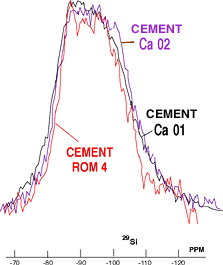
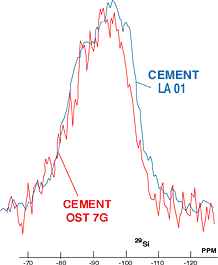
We found at least two specimens of Roman cement (ROM 4 and OST 7G) whose 29Si NMR Spectrum show the same resonances as those of GEOCISTEM cements. The spectrum for the cement ROM 4 (Opus Signinum) is similar to the spectra of Ca 01/Ca 02 GEOCISTEM cements. These particular GEOCISTEM cements were made of MK-750 (or kandoxi) and zeolithic tuffs Ca01, Ca02 (philipsite type). The spectrum for the cement OST 7G is equivalent to the LA01 GEOCISTEM volcanic tuff cement .
Comparative 29Si NMR spectra for Cements ROM 4/Ca 01,
Ca 02 GEOCISTEM (left), and Cements OST 7G/LA 01 GEOCISTEM (right).
ROM 4 results from the reaction between lime and a special ceramic testa different from plain kaolinitic clay. This chemical reaction yields an alumino-silicate structure (polysialate geopolymer type) with a major resonance at -86 ppm suggesting a structure of the Si(Q3Si,1OH) and Si(Q4) types, or a hydrated felspathoid geopolymer analogue. In addition, the presence of hydrated gehlinite in ROM 4 cement deducted from 27Al Spectroscopy suggests following final make-up for ROM 4 cement:
- hydrated gehlinite,
- recarbonated lime,
- hydrated feldspathoid, (K,Na)-polysialate geopolymer,
- fine grained zeolitic volcanic tuff.
The 29Si NMR spectrum of OST 7G cement is equivalent to the one of the LA01 GEOCISTEM volcanic tuff cement. OST 7G mortar results from the reaction between lime and analcime type cretoni. The product of this reaction is an alumino-silicate of type Si(Q3, 1OH) and Si(Q4) (-86 ppm to -94 ppm range) different from those expected with regular pozzolan. There is no hydrated gehlinite in OST 7G cement deducted from 27Al Spectroscopy. The final make-up of OST 7G cement would be:
- recarbonated lime,
- hydrated feldspathoid, Na-polysialate geopolymer,
- fine grained zeolitic volcanic tuff.
Hydrated feldspathoid and hydrated gehlinite are X-ray amorph. This explains why the chemical and mineralogical analysis carried out by the GEOCISTEM geologist team at Cagliari University on these ancient mortars, did not provide detailed information on the make-up of the lime-cement.
See also in The Mystery of Roman Concretes unveiled .
