
Summary of the Conference
by Joseph Davidovits
Vth International Congress of Egyptology, Cairo, Egypt,
Oct. 29-Nov.3, 1988.
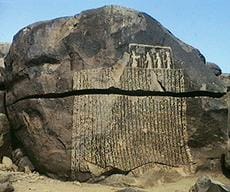
Egyptologists have long claimed that no records exist which describe how the Pyramids were built. A stone stele is engraved on a rock at the island Sehel, near Elephantine, Egypt, north of Aswan. It was discovered in 1889 by C.E. Wilbour and was deciphered by various egyptologists: Brugsch (1891), Pleyte (1891), Morgan (1894), Sethe (1901), Barguet (1953) and Lichtheim (1973). This stela features three of the most renowned characters of the Egyptian civilization:
- Pharaoh Zoser, around 2,750 BC, built the first pyramid, the Step Pyramid at Saqqara. This monument is claimed to illustrate the invention of building with stone.
- Imhotep, scribe and architect of Zoser’s pyramid, who has been honored and deified for having invented the building with stone.
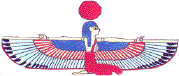
- God Khnum, the potter who, as in the Bible, is fashioning the bodies of humans and gods with the Nile silt, with clay, in other words processing minerals.
Called The Famine Stele, it was engraved during a recent epoch, under the Ptolemees (200 BC), but certain reliable clues have led egyptologists to believe that, in an amplified form it had already become an authentic document by the beginning of the Old Kingdom (2,750 BC).
Yet, the most controversial aspect of this text resides in the fact that to build temples, pyramids and other sacred buildings, Khnum’s instructions and Imhotep’s revelations do not mention any contructional stone, such as limestone or sandstone or granite blocks. These materials are not found in the list. In Zoser’s dream (col. 19) Khnum is giving minerals and “since former times nobody ever worked with them to build the temples of the gods..”. To build monuments, Zoser was given a list of minerals and ores whose hieroglyphic names have not been translated so far. This is the reason why we started an in-depth study of each hieroglyphic word, in order to determine the technical key-words, those which are obviously difficult to translate.
Technical Key-words not translated by previous authors:

Word ‘aa’: This word is translated “pyramid” by Brugsch, “tombs for kings” by Sethe and Barguet, and “palaces for kings” by Lichtheim. All translations relate to the hieroglyphic word ‘aa’ and the determinative for pyramid. According to Sethe and Barguet, this word ‘aa’ is an archaism from the Old Kingdom.

Key-word ARI KAT: This verb occurs three times. In col. 13 and 19, associated with minerals, it has been translated by: “to work with”; in col. 20, the god Khnum “fashions” or “creates” humanity (with clay). The first part of the verb, ARI, means to make, to create, to form, to fashion, to beget; the second part, KAT and the ideograph “man”, means the work done by man. The adjective, ARI, designates an artificial material, for example synthetic lapis-lazuli. The best meaning for the verb, ARI- KAT, could be to process, to synthesize, to manufacture.

Key-word ideograph RWD: Found in col. 11, this ideograph is part of a sentence which qualifies the materials employed for building temples and pyramids (col. 11 and 12).
Translated by Barguet as hard stone, RWD has been thoroughly discussed by Harris (1961) who states (p.23) that ”…in all events, there can be little doubt that RWDT is a term for hard stone in general, though which stone would come into the category it is difficult to say, especially in view of the reference to alabaster as RWDT”.
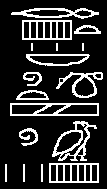
Yet, generally, the element RWD refers to Egyptian sandstone (INR RWDT not listed here), more precisely the stone material found in the quarries of Southern Egypt, and used to built the temples of the New Kingdom and Late Periods at Karnak, Luxor, Edfu, Esne, Denderah, Abu-Simbel. This material, Egyptian sandstone is a soft material, which, in some cases can be easily scratched by the fingernail (Rozière, 1801). It is the contrary of a hard stone. It is two times softer than Giza limestone, four times softer than Carrara Marmor or eight times softer than Aswan granite. It becomes obvious that the element RWD does not mean hard stone.
On the other hand, the ideograph RWD also means: germinate, grow, and the causative verb, S-RWD, to make solid or to tie strongly. Gravel and pebble contain also the ideograph RWD. Finally, sandstone, quartzite, in some cases granite, and other stones qualified with RWD, are the natural solid stones resulting from the geological solidification of aggregates, such as sand or quartz particles.

Key-word AAT: Col. 16 gives the different names of AAT. According to Harris (p.21) AAT is to be regarded as a word for minerals, and refers to ores. In col. 19, these ores are processed for the first time, yielding the invention of building with stone materials.

Key-word TESH: The composite word AAT NEB RWD UTESHAU, at the end of col. 11 is of particular interest. Barguet translates: ‘matières precieuses et pierres dures des carrières’, but states in a note that his reading may be doubtful due to the strange writing of this word, in hieroglyph. Instead of TESHAU, Barguet reads SHETI.
The root TESH has the general meaning of: crush, separate, split, and the verb BETESH indicates the action of dissolving, disaggregation. A stone which is crusched, or disaggregated, or split, is called an aggregate.
This leads us to conclude that the word RWD UTESHAU indicates any natural aggregate, or naturally split material, such as weathered and naturally disaggregated material. RWD could be extrapolated as being the ideograph describing agglomeration, here at the beginning of the word, or of agglomerated stone (geologically or man-made) when put at the end.
If our assumption is right, the stony materials listed in col.15 should be in a loose form, or easy to disaggregate. Two names contain the root TESH, four names do not.

The BEKHEN stone has been found in inscriptions located in the Wadi-el Hammamat, in the desert South-East of Aswan, and is referred to as being either black basalt, or diorite, or sandy skist, or porphyry, or greywacke, or psammite gneiss (Lucas and Rowe, 1938; Morgan, 1894). Yet, according to the Hammamat Inscriptions (Couyat-Montet), quarrying of BEKHEN at the Wadi-Hammamat was carried out in a very primitive way. The chosen blocks were generally thrown down to the bottom of the mountain where they arrived split into numerous lumps.

The MTHAY stone is more interesting to discuss. This name seems to contain the root of the word MAT which means granite. Harris (p.72) agrees with Barguet when he notes that it is strange that granite is not otherwise mentioned in the text. Since it was the most typical stone of this region, it is therefore the more likely that this remarkable form of writing conceals MAT, i.e. granite. However, except for the peculiar hieroglyphic orthography which occurs in the Famine Stele, the referenced writings for granite always contain the same hieroglyph, the sickle MA, with different adjectives. In col. 15, the letter ME is not the sickle, but a denuded bird, without wings and feathers. This way of writing the letter ME is to be found in the word MUT, to kill himself. The word METH also means to die. On the other hand, the granite MAT is often written with the ideogram heart, life, suggesting the idea of living granite. Assuming that the writer of the Famine Stele wanted to stress, in a condense form, that the granite is a weathered, loose, disaggregated material found in some geological outcrops, he could have tried to emphasize the idea of dead granite.

Key-word AIN: Col. 15 begins with: Learn the names of AIN (stone). The hieroglyphic word for solid stone, constructional stone and block, is AINR. The majority of solid rocks is called AINR, with an adjective. Harris makes no distinction between AIN and AINR, the coptic word for stone, ONE, being very similar to AIN. However AINR is essentially applied to stone used in building. AIN should be recognized as a generic word for stone, as a substance, i.e. a stony material, in opposition to other materials like wood or metal.

Key-word ideograpgh: The phonetic value of this ideograph is not known; from the dictionary, it is a determinative for smell and odor, but is not associated with perfumes. It essentially relates to substances which give out smells, effluxes or emanations. Yet, these odors are not necessarily bad, and it does not mean to stink. Sometimes this ideograph has been associated with the notion of pleasure.
Found in Col. 12, it is for Brugsch a word for unguent (in German “salbe”). Barguet and Lichtheim do not translate it using the general term “products” in connection with those cited in col. 11, ‘aat nb rwd uts3u’ the minerals and stones.
The ideograph could represent a bladder or a vase containing a liquid, which gives out an odor, but is not a perfume. In other words it could be the determinative for chemical product. The majority of chemicals have a characteristic smell, and chemists have learned how to detect, recognize and associate any peculiar odor. According to col. 11 and 12, those products which smell are the ores and stone materials which are essential for the building of temples and pyramids.
Lexicographs studying ancient minerals make the assumption that their names should derive from their color. They rely on the fact that, in ancient Greek, various gem names are closely associated with a color, for example the semi-precious stones containing the root chryso, yellow. The minerals, ores and stone materials, featured in Barguet’s, Harris’ and Lichtheim’s translations of the Famine Stele, demonstrate that this type of lexicographical research is not successful. The majority of hieroglyphic names has not found any contemporary equivalence. We think that, by introducing the concept of odor, and perhaps later that of taste, we are simply following the ancient and classical methods of characterization of chemicals, namely the determination of their color, odor and taste.
Products having an odor are to be found in a text related to the Great Pyramids. In his Book II, Euterpe, the Greek historian Herodotus relates what priests at Memphis told him on the pyramid of Cheops: “Engraved on the pyramid in Egyptian characters is the amount spent on the workers in horseradish, onions and garlic; and the person who interpreted these inscriptions for me told me, as I remember well, that this expense came to sixteen hundred talents of silver. (more than 100 Million Euro of 2001)”. Popular imagery is found in this description and the workers are described as stinking of garlic and onions.
We have claimed (Davidovits, 1978, 1982) (see also books from J. Davidovits ) that this description relates to the cost of the expeditions undertaken for collecting minerals of the arsenate types, located in the turquoise and copper mines of the Sinai. A simple method in petrography for the identification of natural minerals and ores is to heat them with a small blow lamp. If they immediatly release a smell of garlic, they belong to the arsenate family (arsenate of copper or of iron).
We looked at the hieroglyphic names of minerals and ores which could contain the meaning of onion, garlic, radish. We found a representative for each of these 3 odors:
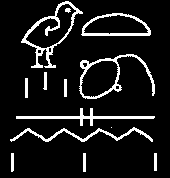
The onion-stone: in col. 15 the “uteshi stone” ends with an ideograph which has been the subject of discussion. Brugsch reads HEDSH, and gives the meaning white, whilst Barguet reads differently, and does not translate, whereas Harris states from the photograph that the reading must remain in doubt. Our reading from the photograph is HEDSH, but our translation is onion. The uteshi stone could be the stone which smells like onion.
The garlic stone: Garlic has been suggested for HUTEM and TAAM, i.e. the root word TEM. In col. 16, the ore TEM-IKR could represent the garlic stone, the prefix KR meaning weak, i.e. the stone which has a weak smell of garlic.
The radish stone: Radish corresponds to KAU and KA-T. In col. 16, the ore KA-Y could mean ‘ore with a smell of radish’.
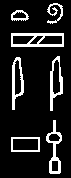

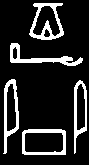
UTESHUI HEDSH (onion , left), TEM (garlic, center), KA-Y (radish, right)
The translation introduces the elements discussed above:
(Col. 11): There is a mountain massif in its eastern region (of Elephantine) containing all the ores, all the crushed (weathered) stones (aggregates suitable for agglomeration), all the products
(Col. 12) sought for building the temples of the gods of the North and South, the stalls for sacred animals, the pyramid for the king, all statues that stand in temples and in sanctuaries. Moreover, all these chemical products are set before the face of Khnum and around him.
(Col. 13)…there is in the midst of the river a place of relaxation for every man who processes the ores on its two sides.
(Col. 15) Learn the names of the stony materials which are to be found…bekhen, dead (weathered) granite, mhtbt, r’qs, uteshi-hedsh (onion stone),… prdny, teshy.
(Col. 16) Learn the names of the rare ores located upstream…gold, silver, copper, iron, lapis-lazuli, turquoise, thnt (chrysocolla), jasper, Ka-y (radish stone), menu, esmerald, temikr (garlic stone), more over, neshemet, ta- mehy, hemaget, ibehet, bekes-ankh, green make up, black antimony, red ochre…
(Col.18).. .I found the god standing.. .he spoke to me: “I am Khnum, your creator, My arms are around you, to steady your body, to
(Col. 19) safeguard your limbs. I bestow on you rare ores upon rare ores… since creation nobody ever processed them (to make stone) for building the temples of the gods or rebuilding the ruined temples…”
The Famine Stele describes the invention of building with stone attributed to Zoser and Imhotep, builders of the first pyramid, the Step Pyramid at Saqqara (2,750 BC). According to the text, this invention of building with stone occurs through processing different minerals and ores which could be chemicals involved in the fabrication of man-made stone, or a type of concrete.
Famine Stele: Columns 11-19 (read from right to left)








