Category Science

Introduction to the geopolymer science


The remarkable achievements made through geosynthesis and geopolymerisation include mineral polymers (geopolymers), flexible ceramics which transform like plastics at low temperatures, ceramic composite made at room temperature or thermoset in a simple autoclave, concrete which after 4 hours has higher strength and durability than the best currently-used concrete. Resulting from this are industrial applications which, [...]

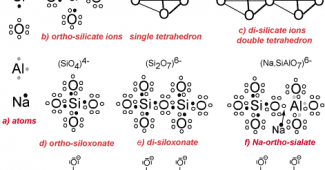
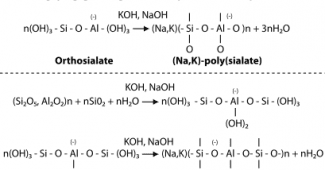
Geopolymerization is a geosynthesis (a reaction that chemically integrates minerals) that involves naturally occurring silico-aluminates. The silicon(Si) and aluminum (Al) atoms react to form molecules that are chemically and structurally comparable to those binding natural rock that allows for products to exhibit the most ideal properties of rock-forming elements, i.e., hardness, chemical stability and longevity [...]

X-rays diffraction spectra of hardened geopolymeric materials (resins and cements) do not provide accurate information (amorphous structure). High-resolution MAS-NMR (Nuclear Magnetic Resonance) spectroscopy of 29Si and 27Al is a very powerful tool that provides useful structural data.
For more updated information, see in Davidovits’ book, GEOPOLYMER Chemistry & Applications, the Chapter 4. You may also [...]

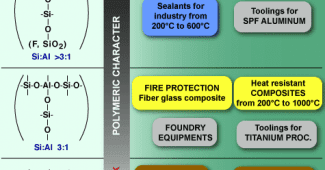
The atomic ratio Si:Al in the poly(sialate) structure determines the properties and application fields. A low ratio Si:Al (1,2,3) initiates a 3D-Network that is very rigid. A high ratio Si:Al, higher than 15, provides polymeric character to the geopolymeric material. One third of Davidovits’ book, GEOPOLYMER Chemistry & Applications, is dedicated to applications. See the [...]

Technical Data Sheet for Geopolymeric cement type (Potassium, Calcium) – Poly(sialate-siloxo) / (K,Ca) – (Si-O-Al-O-Si-O-), Si:Al=2:1
Further details in Davidovits’ book, GEOPOLYMER Chemistry & Applications, Part III, Properties, Chapters 15 to 18, GEOCISTEM , GLOBAL WARMING, and also previous papers in the Geopolymer Library.
Tested on standard sand mortar prisms:

setting: 10 hours at -20°C to 7-60 minutes [...]

Geopolymeric cements are ideal for environmental applications, such as the permanent encapsulation of radioactive and other hazardous wastes, toxic metals, as well as sealants, capping, barriers, and other structures necessary for remedying toxic waste containment sites (see our Research Project GEOCISTEM and the GEOPOLYTECH® process). In the Library, three papers are dealing with this topic, [...]

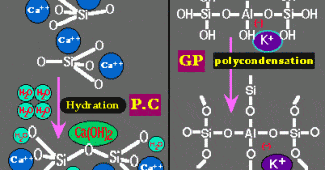
Left: hardening of Portland cement (P.C.) through simple hydration of Calcium Silicate into Calcium Di-Silicate hydrate and lime Ca(OH)2.
Right: hardening (setting) of Geopolymer resin (GP) through poly-condensation of Potassium Oligo-(sialate-siloxo) into Potassium Poly(sialate-siloxo) cross linked network.

Geopolymeric binders, used either with rock aggregates to produce rock-concretes or with carbon fibers to produce non-flammable composites, have a variety of important industrial uses.
The same geosynthesis that produces geopolymeric rock-cements is used industrially for making binders for advanced composite materials. Updated research is presented in Davidovits’ book, Geopolymer Chemistry & Applications, Chapters 8, [...]

Procedure used in the fabrication of a ladle for aluminum casting (800°C)

Step 1: Impregnation of fabric
(ceramic fiber) with GEOPOLYMITE resin

Step 2: first ply

Step 3: first lay

Step 4: impregnation of last ply

Step 5: Demolding after cure at 80°C

Step 6: Operating ladle at 800°C