
Are Pyramids Made Out of Concrete?
Pyramids (1) Are Pyramids Made Out of Concrete?
Pyramids (2) The evidences
Pyramids (3) The formula, the invention of stone
Pyramids (4) Videos and book
Pyramids (5) FAQ for artificial stone supporters
Pyramids (6) Deep misleading publications by geologists
The scientific proofs
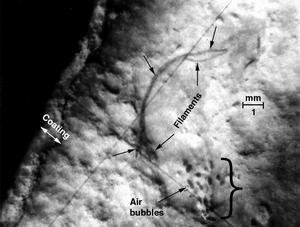
The “Lauer” sample under the optical microscope.
This photo shows a sample of the casing from the ascending passage of Kheops great pyramid, given by the French egyptologist Jean-Philippe Lauer in 1982 to J. Davidovits. Now, the cross section is characterised by the presence of organic fibers and air bubbles that do not exist in normal situation, especially in a 60 millions years old limestone from the eocene ere !
Ref.: X-Rays Analysis and X-Rays Diffraction of casing stones from the pyramids of Egypt, and the limestone of the associated quarries., Davidovits J., Science in Egyptology; A.R. David ed.; 1986; Proceedings of the “Science in Egyptology Symposia”; Manchester University Press, UK; pp.511- 520.
We recently (May 2020) detected a fraudulous scientific study carried out by geologists to discredit our research. They used a false “Lauer” sample. Go to Pyramids (6) Deep misleading publications by geologists
Another study used Nuclear Magnetic Resonance Spectroscopie
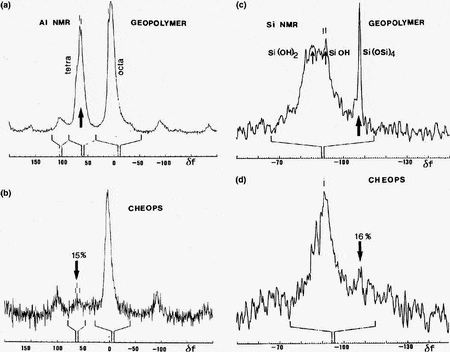
Al and Si NMR spectra of a geopolymer (A and C) are also found in a Kheops stone (B and D). The Kheops stone may hold 15% of artificial geopolymeric cement.
The nuclear magnetic resonance spectroscopie depicts similarities between a Kheops stone and a reconstituted stone.
Ref.: PIXE, PIGE and NMR study of the masonry of the pyramid of Cheops at Giza, Guy Demortier, NUCLEAR INSTRUMENTS and METHODS in PHYSICS RESEARCH B, B 226, 98 – 109 (2004).
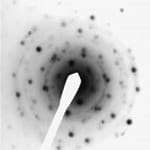
 Left: electronic diffraction of amorphous alumino-silicate from a Kheops casing. Right: electronic diffraction of a natural alumino-silicate (illite) from the Turah quarry near Giza.
In natural stones, we expect to find elements that had the time to cristallize. However, silicates in pyramids stones are completely amorphous (not cristallized). This allows us to think that we are in presence of a cementitious process. The silicates were formed in a very short period of time. Read the paper abstract
Ref.: Barsoum, M. W., Ganguly, A. and Hug, G. (2006), Microstructural Evidence of Reconstituted Limestone Blocks in the Great Pyramids of Egypt, Journal of the American Ceramic Society 89 (12), 3788-3796. More details are found in Davidovits’ recent book in English (2009) Why the Pharaohs built the Pyramids with fake stones, and scientific background information in Geopolymer Chemistry & Applications.
We can also quote the following scientific papers:
- Paleomagnetic investigation of the Great Egyptian Pyramids, Igor Túnyi and Ibrahim A. El-hemaly, Europhysics News 2012, 43/6, 28-31.
- Were the casing stones of Senefru’s Bent Pyramid in Dahshour cast or carved? Multinuclear NMR evidence, Kenneth J. D. MacKenzie, M. E. Smith, A. Wong, J. V. Hanna, B. Barryand M. W. Barsoum, Mater. Lett., 2011, 65, 350.
- Microstructural Evidence of Reconstituted Limestone Blocks in the Great Pyramids of Egypt, Barsoum M.W., Ganguly A. and Hug G., J. Am. Ceram. Soc. 89[12], 3788-3796, 2006.
- The Enigma of the Construction of the Giza Pyramids Solved?, Scientific British Laboratory, Daresbury, SRS Synchrotron Radiation Source, 2004.
- Differential thermal analysis (DTA) detection of intra-ceramic geopolymeric setting In archaeological ceramics and mortars., Davidovits J.; Courtois L., 21st Archaeometry Symposium; Brookhaven Nat. Lab., N.Y.; 1981; Abstracts P. 22.
- How Not to Analyze Pyramid Stone, Morris, M. JOURNAL OF GEOLOGICAL EDUCATION, VOL. 41, P. 364-369 (1993).
- Comment a-t-on construit les Pyramides: polémique chez les Égyptologues, HISTORIA Magazine, Paris, No 674, fév. 2003, dossier pp. 54-79 (2003).
These analysis are the first and seem to invigorate J. Davidovits’ theory, and, obviously, more work has to be done. To join the team of scientists and offer your expertise and means of investigation, please, contact us .
The Geological Proof, part 1.
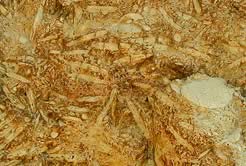
Jumbled fossil shells in a limestone block of the Great Pyramid. Natural sedimentation at sea bottom normally leaves them in horizontal layers.
In prehistoric times most of present-day Egypt was submerged under the sea. The decomposing remains of marine organisms, shells and skeletons, plants, seaweed and algae, fallen to the bottom of the sea, formed mud that condensed itself into a sedimentary rock we call limestone.
A natural process that lasted thousands of years consolidated and hardened them, forming banks of limestone. The pyramid blocks are made of this limestone, a sedimentary rock formed from skeletons and large fossil shells of marine organisms. These fossil remains are normally found in sedimentary horizontal layers. Yet, in the stones of the Great Pyramid, Professor Davidovits found them in disarray, jumbled up together quite haphazardly as if they were artificially mixed with some kind of pestle.
Another phenomenon observed in the pyramid stones was the presence of air bubbles, organic fibers, bones and animal teeth, foreign materials never found in natural limestone – which would seem to be further proof that the stones were man-made.
Fossil shells
The numilitic limestone (the jumbled fossil shells in pyramid stone)
Mr. XX.. does not specify why he thinks that intact fossil shells in the pyramid blocks prove that they are not concrete. If Mr. XX.. had even the most fundamental knowledge of the cast-stone theory, he would know that the fossil shell rubble of the Giza quarries provided the aggregates for the pyramid blocks.
I hope that Mr. XX.. is not merely repeating Dr. Mark Lehner’s ill-considered critique of the cast-stone theory. In 1988, Dr. Lehner used this very same argument to convince NOVA that the cast-stone theory is bunkum. Even as late as the filming of “This Old Pyramid,” when Lehner and his colleagues on the NOVA staff were busily trying to discredit Davidovits and the cast-stone theory, they still did not understand the basis of the theory. This is a sad affront to science. Their lack of knowledge is demonstrated by the fact that when Dr. Davidovits went to the Giza quarry to examine the limestone, he was driven to the spot by one of Lehner’s assistants (whose name is unknown to me). Dr. Davidovits told me that this assistant turned to him as they were driving along and said, “We know you are wrong.” Dr. Davidovits replied by saying something like, “Oh really? I have researched and studied for over 20 years and you know I am wrong. How is that?” The assistant said, “Because there are fossil shells in the pyramid blocks, just as there are fossil shells in the quarries.” Dr. Davidovits replied by saying something like, “Well, where do you think the aggregates for the pyramid-concrete-blocks came from, the Moon? No, the shells came from the quarries.” The assistant’s eyes opened wide and he said nothing.
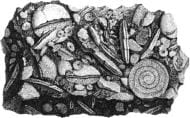
The fossil shells would remain intact for the most part but would be jumbled in pyramids blocks. Why would the pyramid builders make more work for themselves by crushing them? As I stated, “When he participated in the filming of NOVA’s “This Old Pyramid”, Dr. Davidovits showed how easily wet Giza bedrock comes apart and releases clay within 24 hours. Sadly, his 10-minute demonstration showing how to make geopolymeric pyramid blocks with Giza limestone was cut from the film in the 1997 edited version.” In other words, the quarry material is rather loosely bound by clay. The clay releases in water so that the shells are no longer bound. Once the shells are loosened, they can be gathered as aggregate. For full information on making geopolymeric concrete in situ in the quarries, see the debates published in the Journal of Geological Education (see the Library for the list of references and also Archaeology applications ).
The Geological Proof, part 2.
Geological Knowledge of the Pyramid Plateau, hard limestone and soft limestone
The Figure displays a simplified cross-section of the Giza Pyramids Plateau. The Giza Plateau is an outcrop of the Middle Eocene Mokkatam Formation. A second outcrop of the Upper Eocene Maadi Formation borders the Pyramids Plateau on the South-South West. A large sandy wadi separates the Mokkatam Formation from the Maadi Formation, created by the South-East dip of the Mokkatam Formation. The North side of the wadi, or the southern line of the Mokkatam Formation outcrop, and the South side of the wadi, or the northern line of the Maadi Formation outcrop, where both Formations dip into the wadi, were extensively quarried during the erection of the Giza pyramids.
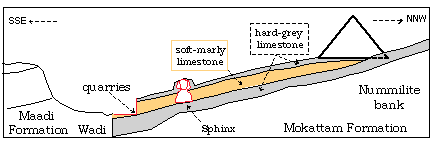
Simplified NNW-SSE cross-section of the Giza Plateau. The soft-marly nummulite limestone bed (in yellow) that was extensively quarried (Wadi quarries, Sphinx trench) is sandwiched between two hard-gray nummulite limestone beds (pyramids basement and Sphinx head).
According to geologist Thomas Aigner and egyptologist Mark Lehner, the original ground surface of the Mokkatam Formation that constitutes the basement of the pyramids, is made of a very hard and massive limestone bank of the nummulite type (gray limestone banks on the Figure). On the opposite, the outcrop that dips into the wadi, where the quarries are located and also the trench around the Sphinx and the Sphinx body, consist of softer thickly bedded marly nummulite limestone layers with a relative high amount of clay (yellow bank in the Figure). Concurring to the traditional carving theory, Mark Lehner states “… the builders took advantage of the thickly bedded softer limestones of the south part of the Mokkatam Formation, while founding the pyramids on the hard nummulite bank to the north.”
Lehner postulates that the builders did not use the nearby hard limestone but favored the softer material.
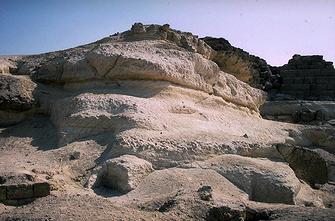 Kheops quarry as designated by geologists. The quarry face shows the soft limestone layer that cannot be used for carving stones.
Disaggregation of soft limestone with water
In October 1991, during the shooting of the TV production “This Old Pyramid” by NOVA, aired on the American PBS network on September 1992, Prof. Davidovits had the opportunity to present this unique property of the Giza limestone. A chunk of limestone taken in the quarry was very easily disaggregated within 24 hours, leaving the nummulites and the clay gently separated from each other, whereas a chunk of the hard Mokkatam limestone did not disintegrate at all.
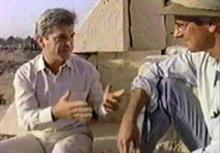
Joseph Davidovits and Mark Lehner in the TV film “This Old Pyramid”, WGBH, Boston, 1992 (NOVA, PBS)
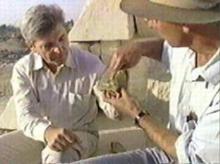
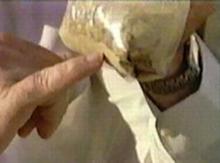
After 24 hour soaking in a plastic bag with water, the limestone chunk separated into clay and mummulites. In the presence of an excess of water, the heavier clay settles down leaving the nummulites separated from each other. “This Old Pyramid”, WGBH, Boston, 1992 (NOVA, PBS)
This topic has been extensively outlined and discussed in the Session F: Applications to Archaeology of Geopolymer Conferences and published; see details in Archaeology applications in geopolymer proceedings.
The Irtysen Stele Proof
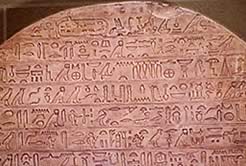
Irtysen Stele at the Louvre Gallery proves that Imhotep’s Formula existed
The Louvre gallery in Paris is where the Irtysen Stele is preserved (room 7 of the thematic circuit). This ancient stone inscription does not go back quite as far as the era when the Great Pyramid was built. But it is very old. Some four thousand years old…
It is the autobiographical funerary stele of Irtysen, a master craftsman of the priestly caste, who lived 2.000 years BC. In this text Irtysen says he possesses a “secret knowledge” to fabricate stone statues, not by carving them but by casting them in molds.
Irtysen affirms he used a material mixture that hardened when cast inside molds to reproduce any kind of object or figure – a material that fire could not consume, nor water dilute. This suggests that Irtysen worked with a chemically-produced binding matter that could be mixed with certain minerals and poured into a mold, to produce statues.
The Sehel Stele Proof
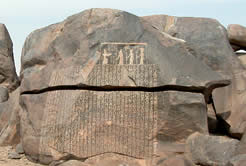
Famine Stele at Sehel Island contains the revelations of Imhotep, with a list of mineral ingredients for a chemical formula.
On Sehel Island, some kilometers downstream from the city of Aswan on the river Nile, an ancient rock can be seen. It is known as the Famine Stele, and its text appears in hieroglyphs occupying 32 columns, that must be read from right to left. The first columns deal with the famine that occurred in the reign of the Pharaoh Djoser, around 3.000 years B.C, in a period earlier than the reign of Kheops.
The engraved hieroglyphs tell the following story: For years, the Nile had periodically flooded its banks, watering the surrounding fields and making them apt for agriculture. In the reign of Djoser, however, the river did not rise. Hence, crops were unable to grow, the soil dried up and became sterile, and the result was a great famine throughout the land.
The stele text was originally deciphered in 1889, but due to the limitations of scientific knowledge of the time, that part containing the formula was misunderstood or not properly translated. Now, professor Davidovits, thanks to his chemical knowledge, has been able to decode its true meaning.
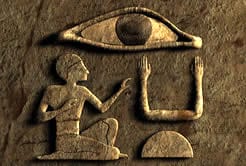
The ARI-KAT hieroglyph, a key to the stone technology
Professor Davidovits was particularly interested however, not so much in the historical passages on the flood as in those which describe a chemical formula used in ancient times by a priest and sage – the great Imhotep – to fabricate an agglomerated block of stone. A section of the stele (known by scholars as “The Revelations of Imhotep”) contains significant words. One of them is ARI-KAT, a composite of two hieroglyphs which form one single adjective. ARI, is a verb meaning “to work with, to fashion, or to form”. It is symbolized by an eye, alongside a seated human figure, which represents the man who does the work. The addition of KAT – two hands held aloft and a semicircle – gives a new meaning: man-made, created by man. ARI-KAT, therefore, is something fashioned by man and, when associated with minerals, something processed or synthetically made.
A discussion of the FAMINE STELE ( read this comprehensive chapter ) was presented at the Vth International Congress of Egyptology, held in Cairo, Egypt, on Oct. 29, 1988. This paper (see the Library to download the full text) is introducing the first study which could be a good step forward in the discovery of other texts. See also Davidovits’ recent book in English (2008) They built the Pyramids.
The Vessels Proof
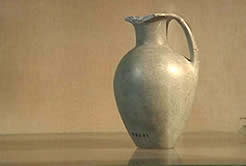
One of Sakkara’s 30.000 stone vessels at the Cairo Museum.
Beneath the earth, below the base of the Sakkara Step Pyramid, Imhotep his builder and designer quarried out almost three miles of stone and built a series of corridors and inner chambers.
He decorated some of the chambers with blue enamel tiles, as far we know the first ever made by man; a proof of his advanced knowledge of alchemy.
In addition to all this, some thirty thousand stone vessels of the utmost perfection were found in these subterranean chambers. There are unique and enigmatic hard stone vessels, made of slate, diorite and basalt. Some of these materials are harder than iron. No sculptor today would even attempt to work with such material.
One wonders how could they have been carved? Their design is extremely beautiful and impossible to carve. No tool marks are found on their surfaces. They must have been cast in molds, in accordance with the indications suggested by the Irtysen Stele at the Louvre gallery. See also more details on the Fresco of Ti (Vth Dynasty) in Davidovits’ recent book in English (2008) They built the Pyramids.
The Le Chatelier Proof
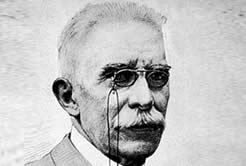
Henri Le Chatelier.
The first man to posit a reasonable solution to how the Egyptians made their stone statues, was Henri Le Chatelier, a chemist, ceramist and metallurgist, born in France in 1850.
In the early twentieth century, he noticed that the famous statue of Pharaoh Khafra (or Khefren) revealed no sign of tool marks. Yet it had been made of diorite, the hardest type of stone, at a time when artisans possessed only simple stone or copper chisels. He concluded that with tools like these it would have been impossible to produce such a masterpiece.
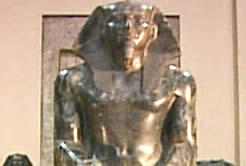
Diorite statue of Pharaoh Khefren.
Le Chatelier suspected that it had not been carved at all, but made of agglomerated stone cast in molds, so he began to examine other statues. He looked at ones that were apparently enameled, and cut thin sections of them with a diamond-tipped saw, and found that the enamel was not an applied coating but part of the material from which the statue was made. He asserted that they were cast in some kind of synthetic material not sculpted in natural stone.
